


Authors VINCENT OKOTH & CHARLES MERCY
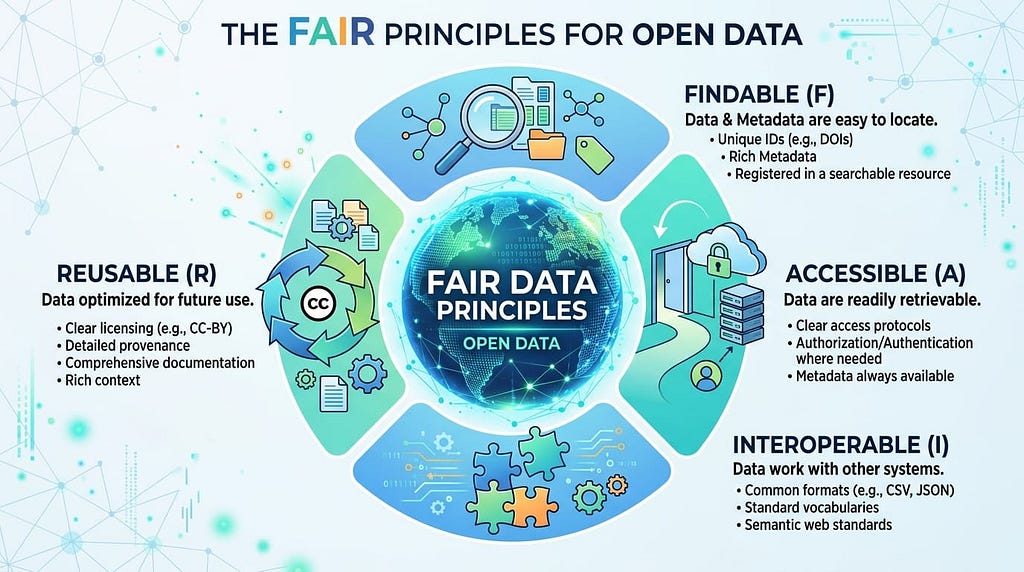
Open Data cannot be defined without involving the aspects of availability, accessibility, usage and licensing which generally speaks of public participation. In accordance with UNESCO, open data is any processed information that adheres to the FAIR principles, that is, of being Findable (easily located and retrieved), Accessible ( it should be easy to obtain through authorization and standardized protocols), Interoperable (should be interchangeable with other data and flow of work for data processing), and Reusable (should be replicable to achieve maximum reutilization of data). Whereas, the European Union defines open data as any processed information from public bodies that is available for reuse with emphasis on economical, societal and innovation benefits. In Kenya, open data refers to data in machine-readable format that is openly available for the community with legal features enabling reutilization and redistribution, and in this case, does not entail personal information attributed to a specific subject.
Globally, 55% of countries have formally adopted policies on open data with new initiatives emerging from Latin America, Asia and Africa. The report from the Open Data Inventory (ODIN,2025) assessed 197 countries, with the results showing Malaysia, Poland, Singapore, Denmark, Finland and Norway respectively top with rankings of 89+ ratings on openness and coverage of Open Data. However, Turkmenistan, South Sudan, Venezuela, Monaco and Nauru are lagging behind with average ratings of below 22. Even though the adoption of open data is rising, the process of making data open remains a challenge with about 90% of government datasets still not being publicly accessed, is outdated, incomplete, in formats difficult to analyze and understand, or lacking documentation to make them useful.
The Open Data Watch report revealed that Africa has made great progress in adopting and implementing open data initiatives, although performance remains inconsistent across the countries with Burkina Faso and Morocco topping in Africa with 77 ratings each and ranked 24 worldwide, whereas South Sudan trailing bottom in Africa with ratings of 20. Between the years 2022–2024, Africa reported the largest regional improvement globally with a 23% score increase in data openness and coverage. In Kenya, Open Data is generally defined by the frameworks such as the Constitution of Kenya 2010 ( Article 35), Access to information Act 2016 and Kenya Open Data Initiative (KODI, 2011) through the open data portal as a step to improve transparency, enhance community participation in governance and stimulate innovation. The report also shows that Kenya has made some progress in ensuring data openness with a 62% score in data openness. However, Kenya’s performance still faces challenges.
Open Data is generally defined by the frameworks within ICT and the government’s transparency as any processed information that is freely available, that is, data that can be accessed, used, reused, and redistributed without restrictions to the public. As global open data policies and initiatives are continuing to be adopted, issues affecting open data like poor quality of data, information that is not complete, data format that are non-machine readable, outdated information, limited accessibility, legal and policy gaps, and capacity gaps still persist, regardless of countries like Malaysia and Singapore leading in data openness ratings and Africa showing great gradual improvements as well as gains and Kenya’s Open Data Initiative (2011). Youth-led CSOs like ICON Data and Learning Labs Africa, steps in by promoting data literacy, encouraging responsible ethical open data sharing.
Originally published at https://www.linkedin.com.